Switches

  • While it is possible to install a switch yourself, it is generally recommended to hire

  • Yes, switches can be used in both residential and commercial applications.

  • 1 way is an on/off switch and means there’s only one place you can turn your light on or off. This is the most common kind of switch found in most homes. Most 2 way switches can also be used as a 1 way on/off switch.
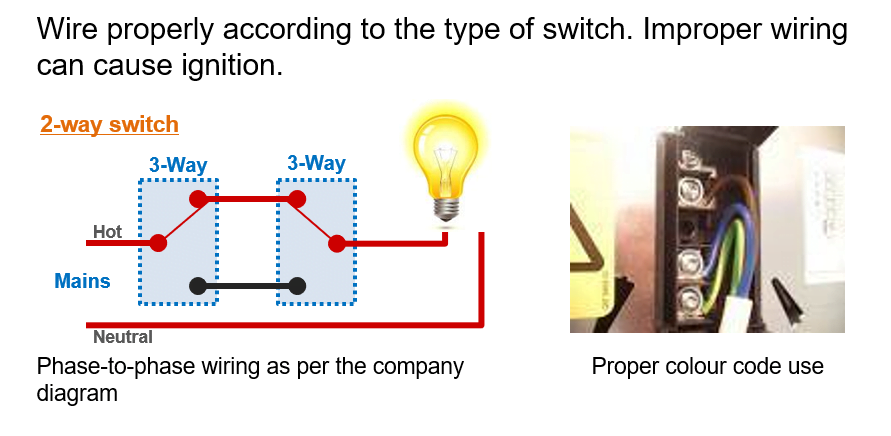
    2 way means there’s another switch controlling the same light. You can turn your lights on or off from two places, for example both at the top and bottom of your stairs. 2 way light switches are also great for large rooms with two doorways where you want to control lights both coming in to, and out of, the room. Most of our switches are suitable for use as a two way.
    Intermediate means you can turn your lights on or off from three places. For example in a bedroom you can turn the main light on or off from a switch at either side of the bed or, a switch by the door. These also work perfectly in large rooms with multiple entrances.

  • The right switch for your project will depend on factors such as the type of circuit and the number of light fixtures or appliances being controlled.

  • Switches should always be installed by a licensed electrician to ensure that the installation is done correctly and safely.

  • How to wire swicthes?

    How to wire

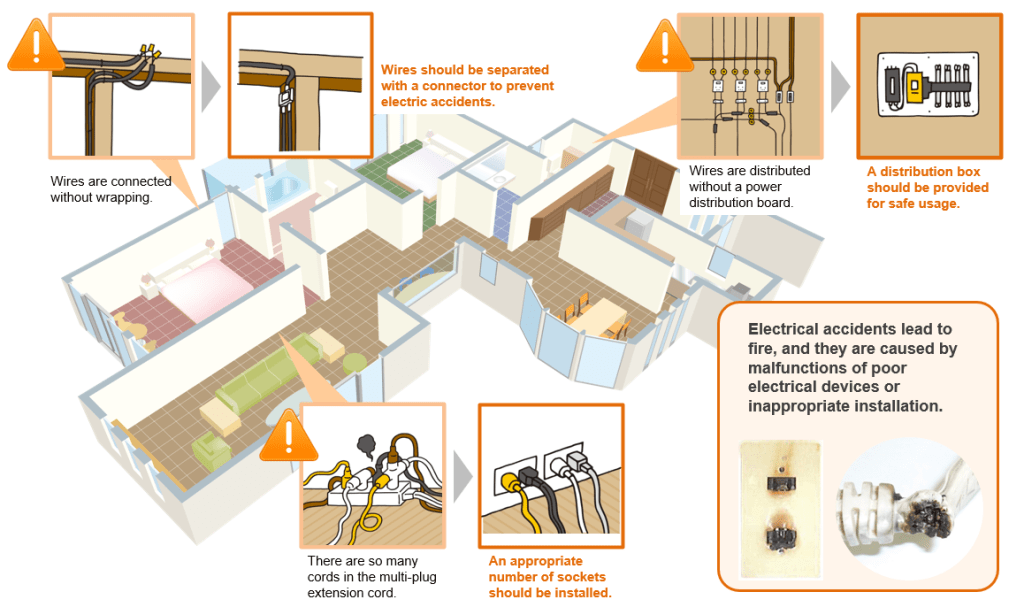
  • Causes of Electrical Leaks

  • switch is a device that is used to turn a circuit on or off, controlling the flow of electricity.

  • AX rating in switch indicate whether it is suitable for fluroscent load or not
  • 1, 2 and 3 gang refers to the actual number of switches (dimmers, throws or rockers) on the plate. For example, a 2 gang dimmer will have two dimmer switches.

  • Answer: Though modern modular switches are designed keeping in mind safety issues, it is good practice not to use an electrical switch if it is:

    Loosening up
    Feeling hot
    Looks burned
    Emanates burning smell

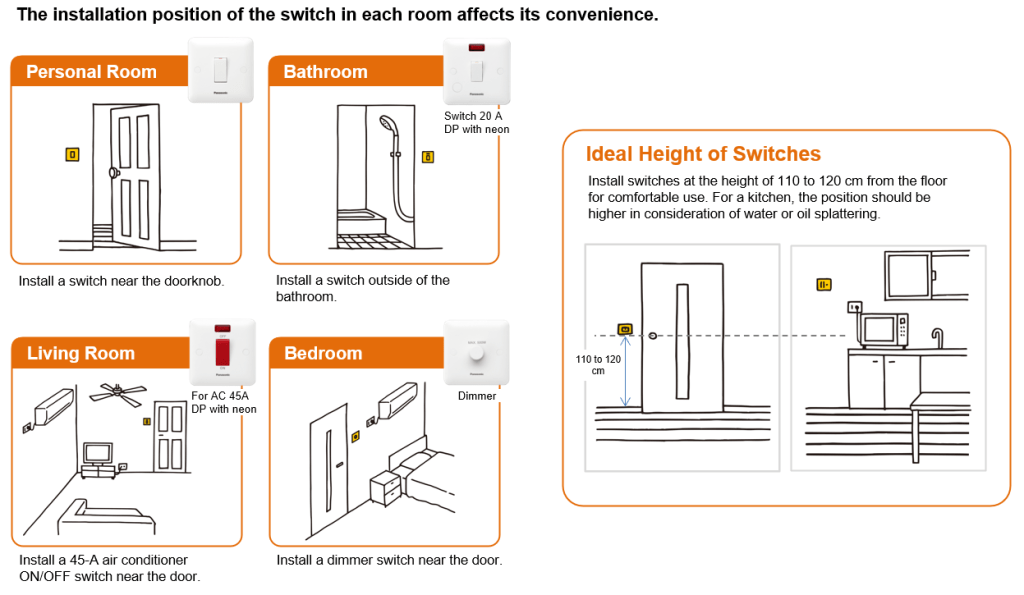
  • Where to install Switches?

    Where to install Switches

Socket

  • There are specially designed weather-resistant wiring device sockets available for outdoor use. These sockets provide protection against environmental elements and are suitable for outdoor installations.)

  • The right socket for your project will depend on factors such as the type of circuit, location, and usage. For example, W/P sockets are recommended for wet areas likeout side bathrooms and kitchens etc.

  • To choose the right wiring device socket, consider factors such as the socket type, voltage rating, ampere rating, durability, aesthetics, and whether you need additional features like USB charging ports or switches.

  • It is recommended to periodically inspect and maintain your wiring device sockets to ensure safe operation. Regularly check for signs of damage, loose connections, or overheating. If any issues are found, contact a licensed electrician to address them promptly.

  • There are various types of wiring device sockets available, including standard sockets, switched sockets, USB sockets, industrial sockets, and specialized sockets for specific applications.

  • With the proliferation of devices occupying our homes, access to power sockets has become an increasingly frustrating issue. Many phones and tablets are now supplied with USB charging cables, with USB sockets you can plug straight into the wall with the benifit of improvd chaging times.

  • A socket, also known as a receptacle, is an electrical device that is used to connect electrical devices to a power source.

  • It is crucial to turn off the power supply to the circuit or use a circuit breaker lockout device before working on the socket. Ensure proper grounding, use insulated tools, and follow the manufacturer's instructions. If unsure, consult a licensed electrician.

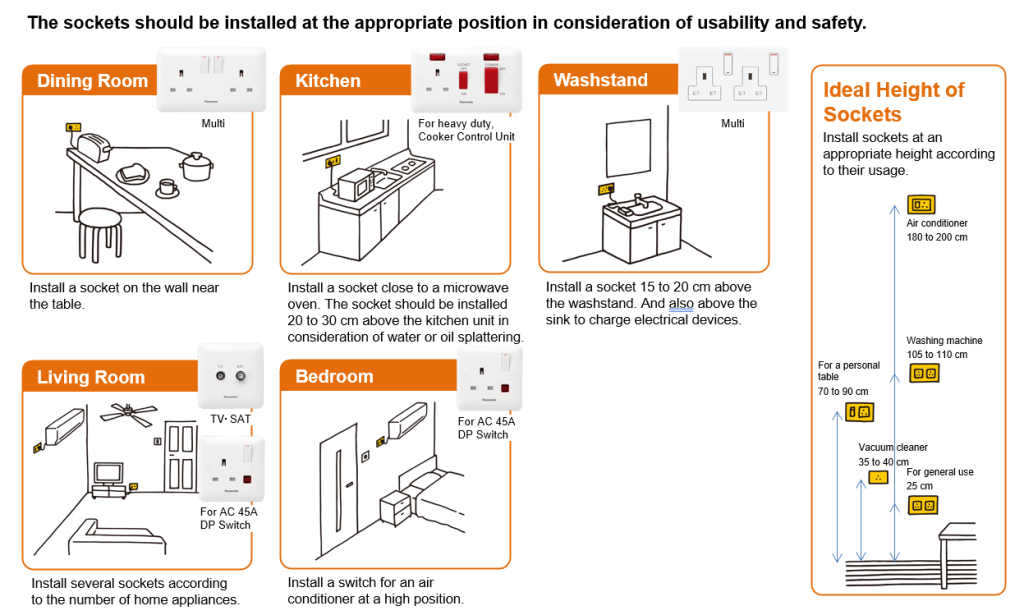
  • Where to install sockets

  • One may also make use of a 5 Amp socket outlet for lighting. This is a non-standard socket with round pins purposely intended for a table or floor lamp.

Accessories

  • The maximum power that can be drawn from a shaver socket is 20VA.

  • A Blank Plate is a cover plate that is used to cover unused electrical boxes or openings in walls or ceilings. It can also be used to mount electrical devices like switches or outlets.

  • Cat 6 and 5 Telephone cables are used for networking and telecommunications purposes. Cat 6 cables are designed to transmit data at higher speeds and are more expensive than Cat 5 cables.

  • A connection cable is a cable that is used to connect two devices together. It is commonly used to connect computers to other devices like printers, scanners, or external hard drives.

  • A dimmer is an accessory that allows you to control the brightness of a light fixture. It works by reducing the amount of electricity that is sent to the bulb, which in turn reduces its brightness.

  • A Do Not Disturb/Make Up Room Input Unit is a device that is used in hotels to allow guests to indicate whether they want their room to be cleaned or not. It is usually located near the door and has buttons or switches to indicate the guest's preference.

  • A Door Chime/Bell is a device that is used to signal when someone is at the door. It is commonly used in residential and commercial buildings.

  • A fuse unit is an electrical device that is designed to protect electrical circuits from overloading or short circuits. It works by breaking the circuit when the current becomes too high, preventing damage to the circuit.

  • A SAT Socket is a type of connector that is used for satellite television systems. It is used to connect the satellite

  • A Shaver Socket is a specialized electrical socket that is designed for use with electric shavers. It typically has a lower voltage output

  • A VGA Connector is a type of connector that is used to transmit video signals between devices like computers and monitors. It is commonly used in older devices and has been largely replaced by newer connectors like HDMI.

  • An Audio Socket is a type of connector that is used for transmitting audio signals. It can be used for devices like speakers, microphones, and headphones.

  • An F Connector is a type of coaxial cable connector that is used for connecting devices like televisions and cable modems to coaxial cable.

  • An outlet, also known as a power outlet or electrical outlet, is a device that is used to provide electrical power to devices like lamps, appliances, and electronic devices.

  • An RCA Connector is a type of plug that is used to transmit audio and video signals. It can be used for devices like DVD players, gaming consoles, and TVs.

  • A non-isolated coax socket is a standard socket. If you wish to install a socket to connect your TV coax lead into, this is what is required. Also, this version must be used for satellite installation as a two way signal is required. The satellite box does not only receive a signal, it also sends a signal back to the satellite dish. An isolated coax socket will block the return signal.

    An isolated socket lets the signal through from the aerial/satellite dish but does not allow any kind of return signal/current. This type of socket would be used where a communal dish or aerial is installed, such as in an apartment block. The isolated socket blocks interference from receivers (televisions, digital boxes, satellite boxes) which spoils the signal which the rest of the users receive.

Floor Box

  • Floor boxes can be installed in a wide range of environments. It is commonly installed in commercial environment such as offices, airports, hotels, hospitals, and schools.

  • The purpose of electrical floor boxes is provide easier access to electrical, data and communication outlets. Our range of floor boxes is designed to be installed in the floor of a builiding to provide connectivity and charging. 

    The user in the building will be able to charge their devices without having to be close to a regular in-wall outlet. Floor boxes are commonly used within schools, libraries, universities and offices where there are multiple of electrical devices. 

  • To install an electrical floor box, first cut a hole in the floor of a suitable size, then position the box inside it so that the lid is flush with the floor surface.

    The unit is then connected to the cables that run beneath your floor. The box is divided into sections, each containing an auxiliary plate as well as the appropriate wiring to allow the end user to charge and connect their electrical devices. 

Extension Cord

  • Panasonic extension cord has a safety shutter preventing from electric shock and is child safe from poking the finger into the socket.

  • Check the device(s) you are plugging into the cord.  Look for their wattage rating/usage.   If the device(s) combined power usage is equal or less than what the cord it rated for, than yes, you can plug them in without issue.

  • Plugging one cord into another is dangerous as it increases the likelihood of overloading which can cause an electrical fire.

  • Extension cords are convenient but using them improperly increases the risk of fire hazards. Plugging in too many electronic appliances may exceeded the maximum amperage that the extension cord can handle.

    In panasonic Extension cord we have an inbuilt Circuit breaker that automatically cuts off power when it exceeds 2,900 watts.

Passive Infrared

  • A Passive Infrared Sensor detects the infrared light radiated by a warm object. All objects with a temperature above absolute zero emit heat energy in the form of radiation. Usually, this radiation isn’t visible to the human eye because it radiates at infrared wavelengths, but it can be detected by electronic devices designed for such a purpose.

  • Panasonic passive infrared sensors have a QUAD sensing element, meaning only one sensor component with four pyroelectric, heat receiving elements which are all interconnected. The lens determines the size and shape of the detection area, as well as the distribution and number of the switching zones.

    Therefore, because there is only one sensor component, it cannot identify where the infrared source is coming from within the detection area.

  • Yes, Panasonic passive infrared sensor are able to detect movement through the interpretation of temperature differentials. A human body can be detected whether it is higher or lower than the ambient temperature. However, since the surface of the human body is affected by the ambient temperature to a certain extent, the sensitivity of the sensor may deteriorate if the body and ambient temperatures equalize.

  • No,PaPIRs are passive infrared sensors, which means that they do NOT emit infrared radiation to detect motion. Instead, the sensor operates by receiving infrared radiation emitted from a moving object. Therefore it is called a “Passive type” sensor.

Weatherproof

  • Panasonic has IP44, IP54, IP55 & IP66 rated Weatherproof sockets, which means they are water and dust resistant, ensuring a stable power source in the face of the weather.

FAQ LED

  • LEDs are light emitting diodes. These are electronic components that convert electrical energy directly to light through the movement of electrons within the material of the diode. LEDs are important because due to their efficiency and low energy, they are beginning to replace most conventional light sources.

  • Although the initial cost of conventional light sources is less than LEDs, the operational and maintenance costs of LED are significantly lower. LEDs, having a longer life, reduce maintenance and lamp replacement cost. Because LEDs need to be replaced less frequently, the owner spends less on new lamps and the labour needed to change them. LEDs also consume less energy; thus the overall cost of a LED system can be significantly lower than that of conventional lighting systems.

  • This is usually due to incompatibility between the driver and the control system. When purchasing an LED product, it is important to use the correct driver type as specified by the manufacturer. It is also important to check that the LED is dimmable. Some retrofits are not.

  • Unlike discharge lamps, LEDs are semiconductors and their life span is not affected by the number of times they are turned on and off.

  • It is crucial to consider the height of the ceiling, the brightness and darkness of the ceiling walls, the walls around the room and the floor. Other variables that should be taken into account and figured out well before any final decisions are taken are which recessed downlight you should use, the type and wattage of the lamp and the purpose of the recessed downlight.

Switchgears

  • MCBs are categorized based on trip curves, which represent their response time to overcurrent: Type B (quick trip for residential use), Type C (medium trip for commercial applications), and Type D (slow trip for industrial uses with high inrush currents).

  • While MCBs primarily protect against overcurrent and short circuits, they don’t offer direct protection against electric shocks. For shock protection, one would need a Residual Current Circuit Breaker (RCCB) or Ground Fault Circuit Interrupter (GFCI).

  • Always ensure the MCB is of the correct rating for your circuit. Periodically inspect for signs of wear or damage. Do not force a tripped MCB to stay on, and always consult professionals for installation or troubleshooting.

  • Small appliances such as microwave ovens, electric iron and electric kettles don’t require an isolation switch when maintenance is done. Air conditioners, refrigerators and exhaust fans need an isolation switch to ease the challenges associated with maintenance and repairs.

  • In higher voltage environments, both circuit breakers and electrical isolators are used. A circuit breaker cuts off the current to the whole circuit and the latter then isolates a section during servicing. Both are needed for ensuring electrical safety.

  • Unlike a circuit breaker, an electrical isolator does not have an arc control system. It can be used only during offload conditions.

Conduit Pipes

  • GI conduits are generally used for cable and wire systems because of their strong ability to tolerate many twists and bends. Overall, GI conduits improve the ability of cables and wire systems to withstand large amounts of weight and longitudinal stress with little distortion or breakage.

  • In practice, these two methods of electrical power cable protection and concealment are very similar. However, they each have their own advantages and disadvantages in particular applications.

    Conduit is typically the cheaper and more basic approach to wiring protection. It’s widely used wherever smaller cable bundles or individual wires are being run between two terminals, from point A to point B. If they simply need to be protected, tidied up, and/or hidden from view, conduit is often the easiest option.

  • GI Conduit is a pipe used to protect and route electrical wiring in a building or construction. It provides very good protection to enclosed conductors from impact, moisture, and chemical vapors.

  • Major types are

    • ANSI ( American National Standard Institute)/ UL (Under Writers Laboratories)
    • BS (British Standard) pipes
    • JIS (Japanese Industrial Standard)
  • Rigid metal conduit / Rigid Steel Conduit ( RSC) - UL 6 ANSI C80.1

    Intermediate metal conduit (IMC) - UL 1242 ANSI C80.6

    Electrical metallic tubing (EMT) - UL 797 ANSI C80.3

    Flexible metal conduit - UL 1

    Liquid-tight flexible metal conduit

  • EMT / IMC – ½ inch to 4’’ RSC – ½ inch to 6 inch

  • BS 4568 Class 4 & Class 3 ( 20mm, 25mm & 32mm)

    BS31 Pipes ¾ inch to 2 inch

Timeswitch

  • A Time Switch automatically controls the use of electricity, turning power on or off at preset times.

  • The timer is a relay having such an output (with or without contact) which electrically closes (turns ON) or opens (turns OFF) the circuit after a preset time elapses when electrical or mechanical input is given.

  • The on-delay operation is an operation to give output when preset time expires after a predetermined input is given to the power supply circuit or input circuit. On-delay operation includes power supply on-delay operation and signal ondelay operation.

  • The off-delay operation is an operation to turn OFF output when preset time expires after a predetermined input is given to the power supply circuit or input circuit, and at the same time output signal is given and predetermined input is turned OFF. Off-delay operation includes power supply off-delay operation and signal off-delay operation

  • Surface Mount, DIN rail Mount

Home Automation

  • KNX is an open data bus standard. It was established for different manufacturers to be able to communicate through a shared data bus. A global communication protocol in Building and Home automation which enables multiple KNX manufacturers work on a single project.
  • Panasonic’s home automation system Thea IQ can control lighting, blinds, HVAC, and security products. Has complete solution from User Interface, Backend KNX modules & User application products  
  • Yes, with Panasonic's versatile 10" Touch panel & IP Interface module can be connected to the Internet enabling remote access over internet. You can access to your smart home system via mobile application, at any time and any place.
  • Wide range 4 to 24 channels, separable upper & lower mechanism i.e., lower mechanism can be installed at site without the upper mechanism which can be programmed & fixed at a later stage.

Fire Alarm System

  • Robust multiple systems such as Fire Alarm, Voice Evacuation, Emergency Lighting & Fire Fighting working in tandem to protect lifes & properties.
  • Most popular standards in MEA region are EN54 (European National Standard) & UL (American Standard)
  • Panasonic's 1st FAS business started in 1960s in Japan, Europe in 1975 & Global market for more than 30 years
  • Panasonic Fire Alarm panels follows EN54 Standard & certified by VdS Germany. It is an Analogue Addressable FAS.
  • Panasonic control panels manufactured in Sweden & Detectors manufactured in Japan
  • Panasonic Smoke detector has AI enabled Advanced Mode coupled with it's unique Learning function to adapt to different environments , smallest mesh net size of 0.3mm to cut down insects, dust entry & the patented drain mechanism for water droplets formed due to condensation/ high humidity reduces nuisance alarms. Detectors are tested twice under real smoke during the production process in Japan for Quality Assurance.
  • Panasonic Control panels & Field devices are Backward & Forward compatible i.e., New control panels can communicate with existing panels & vice versa. So there is no need for replacing your whole FAS.
  • The versatile solutions possible using display unit are 1.Fire Brigade Panel, Alert Annunciation unit, Repeater Panel, General Control panel (Fan, Evacuation & Input). You can now log on to the display and easy navigate through the new intuitive app-based menu. This menu provides easy access to three key functions: acknowledge faults, disable a whole zone or one or more alarm points within a zone or set zones in test mode.
  • Panasonic offers it powerful software EBLWin for programming, testing, commissioning. Both Auto-addressing (soft addressing) & Manual addressing using Address setting tool is possible which makes it very easy & simple.
  • Yes, Integration and connectivity with Remote monitoring possible. The system can be securely monitored and operated remotely, and also be easily connected to building management or security management systems via a gateway with a very user friendly configuration in EBLWin. OPC-UA, Modbus, SIA protocols for 3rd party integration

Solar Panel

  • A photovoltaic (PV) system uses PV cells to convert sunlight into electricity. PV cells are made of semiconductors and are used to assemble PV modules, PV systems also include inverters, to regulate and convert the solar-generated electricity from direct current to alternating current. A great advantage of PV systems is that they are fully scalable and vary in size according to the local energy needs, so they can be used for residential, commercial and industrial electricity needs.
  • 1. Renewable energy source 2. Reduces electricity bills 3. Diverse applications 4. Low maintenance costs 5. Technology development
  • In short, poly means many and mono means one. In regards to solar panels this means that each solar cell is either made with one or many crystals. In general, monocrystalline solar panels are considered to be better quality, but polycrystalline panels are much more affordable.
  • Solar panel systems are made of durable tempered glass and require little to no maintenance for the 25 to 35 years that they will generate power. In most cases, you don't even need to clean your solar panels regularly.
  • This depends entirely on the amount of energy your home uses.